Have you dreamed of acquiring a work of art, or even building your own collection, but have not yet found a starting point? The field of visual arts is vast with a seemingly endless variety of artists, works, media and styles. To help you navigate the art world, we asked collectors to share their tips and thoughts on collecting.
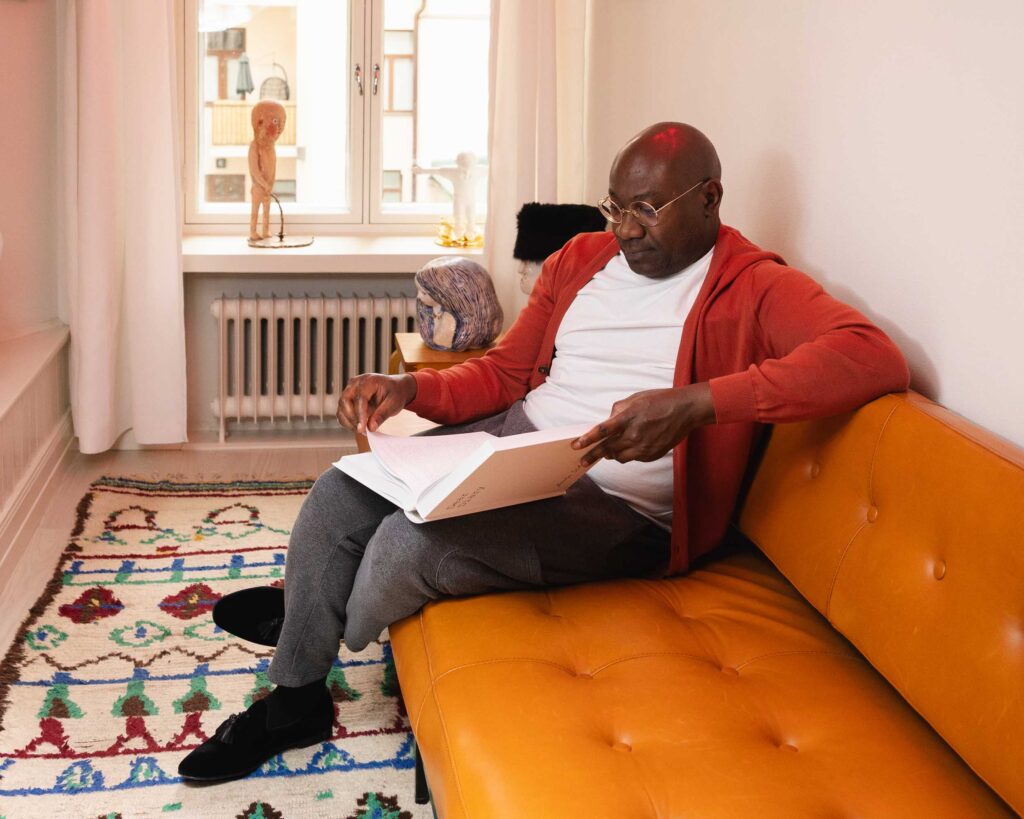
Lincoln Kayiwa is a designer and founder of design studio KAYIWA. Kayiwa’s Ugandan roots and Nordic life blend into designs that are bold and playful, yet still aesthetic, fully functional and durable. Kayiwa is a pioneer in creating unique and limited edition, usable art pieces for collectors and galleries across the world.
We met Lincoln at his art and design-dotted home.

How did you get your start in collecting, and what was the first artwork you acquired?
The first artwork that I acquired [or rather commissioned] was a portrait of me during my first year at university. I still have the work in my storage. When I was younger, I collected — not really artworks per se — but things of sentimental value, including rocks, stamps, and some craft-based works.
You have many different art media represented in your home — photography, sculpture, painting. Is there some kind of thematic or aesthetic interest that guides your acquisitions? What draws you in?
It’s very intuitive. The works have been acquired based on, for instance, how I’m feeling that day, something that takes me back to my childhood memories, a warm summer night, or it could also be a fear trigger. It can be anything, really. Each work has to resonate with me in that sense.
Of course, I’ve been educating myself by visiting museums and galleries, checking out auction sites, getting to know the artists, or attending TEOS, to mention. I keep in the know.
As the collection grows, I think it’s important to have some kind of underlying theme. My focus is Finnish contemporary art, with a special highlight for female artists, as I firmly believe that the future is female.
Case in point, Finland is a very progressive country, but even here Aino Aalto’s designs are largely credited to Alvar Aalto, although she was a great designer in her own right.
This disparity is more visibly apparent in the art world, which justifies the Guerrilla Girls’ poster that asks, “Do women have to be naked to get into the Met Museum?”.
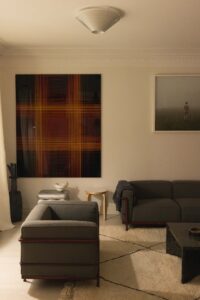
I decided to take an active role. Alongside art, I’ve also been acquiring pieces by female designers such as the living room’s LC3 Fauteuil Grand Confort, grand modèle, that is credited to Le Corbusier, but is in fact designed by Charlotte Perriand. The sofa in the hall is a Florence Knoll. I am currently replacing all the Alvar Aalto plafonds with various models of Lisa Johansson-Pape’s light fixtures, and I have some Maija Heikinheimo designs too.
I rotate the hangings of the works perhaps every three or four years. Lately, when I acquire new works, they go directly to my storage unless it’s something that I can fittingly place on a surface, such as a table or windowsill. The hanging takes a bit of time and planning so that the works speak with each other.

I love that you have placed the artworks and design together very seamlessly. What do you think about this relationship? Does art have a certain specific position in relation to design, or do they complement each other in a home setting?
They must. For me, this is the difference between a gallery and a home setting. Because I live and work in this space, it has to feel cozy and welcoming.
My own practice is making unique or limited-edition designs that are referred to as collectible design, functional art, or sculptural design. The idea being that if one is an art and/or design collector, my creations would complement their collection. I do believe that there should be some sort of dialogue between the art in whichever form and the design in any given space.
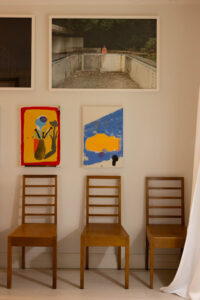
I keep glancing at the series of paintings behind you — vibrant! You have several artworks from a single artist. What does collecting in a series entail for you?
When I was setting out as a collector, I came across this nugget of wisdom. When you are acquiring works from an artist, at least get more than one, preferably up to three. If you’re lucky enough that they make a breakthrough, you’d have made a good investment as well.
On the other hand, artists are usually very complex, dynamic, multi-dimensional individuals whose style might evolve over time. By getting one work, you may not be able to capture their whole artistic spirit.
Do you have any words of wisdom of your own for people who are just starting their collection?
I think collecting is generally dichotomous. Some collect to flip the works, and then there are people who actually passionately collect for the sake of collecting.
Speaking to the passionate audience, collecting is a continuous work in progress. It’s not like you have an instant collection right away. It’s more meaningful to build it over time. However, whereas aspiring collectors should take their time to build their collection, it’s good to understand the art market by keeping in the know, as I illustrated above. If you’re not sure whether the artwork in question would appreciate in value over time, ask a specialist.
Remember, the work doesn’t have to be the most expensive piece in the gallery — it’s about what you can afford. In Finland, many art associations now offer payment plans, allowing you to pay in installments.
Above all, the work must speak to you. With that as a starting point, it’s hard to go wrong. If it doesn’t accrue in value, at least you’ll certainly have an artwork that is meaningful to you. And at the end of the day, that is really the most important thing about collecting.